
Book V
Name, etymology and national symbol
The state name is formed from two genuine Old Norse elements by a genuine Old Norse compound pattern. What follows is the canonical explanation for legal, educational, diplomatic and cultural use.
Canonical forms
Article I · How the name is written
- Official native name: Hrossagrið
- International spelling: Hrossagrith
- Formal state name: The Empire of Hrossagrið
- Citizen / demonym: Hrossagrith, invariant — no singular or plural suffix
- Adjective and cultural term: Hrossagrithic
- Practical English pronunciation: HROSS-a-grith
The correct singular usage is I am Hrossagrith; the correct collective usage is the Hrossagrith people. Use the international th-based forms wherever ð is unavailable or difficult to type.
Core meaning
Article II · What the name says
Hrossagrið means horse-sanctuary, horse-protection, or protected peace for horses and the people bound to them. The central idea is grið: sanctuary, guaranteed protection, safe conduct, legal immunity, protected peace, and the stopping of pursuit or retaliation. The name is not meant to say that the country is merely the horse country. It means a place where sanctuary is real enough that a traveler is protected together with the living bond that carries them.
Etymology
Article III · The compound and its two elements
The name consists of hross + -a + grið — more precisely, of the genitive-plural compound form hrossa- and the noun grið. The internal -a is not decorative and not an English linking vowel: it is the genitive plural ending of hross, giving the first element the meaning “of horses”.
Old Norse compounds are understood from the final element backward. The head is grið: the name is a form, place or jurisdiction of protection, specified by horses — not a horse modified by peace.
The first element: hross
Old Norse hross is a neuter noun meaning horse — an ordinary historical horse-word, not a poetic invention. Its genitive plural is hrossa, and because the uninflected singular and plural can both appear as hross, that form matters: it makes the collective relation explicit. The name does not mean one horse’s protection. It invokes horses collectively.
It belongs to an old Germanic family: Old English hors, Old Saxon hros, Old High German hros or ros, German Ross, Icelandic hross. A commonly proposed deeper reconstruction is Proto-Germanic *hrussą, sometimes connected with an older idea of running, but that derivation is not certain enough to be treated as the official meaning. The secure meaning is the attested one: horse.
The second element: grið
Old Norse grið is a neuter noun used as a collective legal concept: peace, mercy, truce, quarter, guaranteed security, safe conduct, asylum, sanctuary, and protection granted against pursuit or violence. It is not passive tranquility but peace made operative by recognition, promise, custom or law — a truce that requires hostilities to stop, quarter granted to a person otherwise exposed, safe conduct through dangerous territory, or a guaranteed condition in which seizure and retaliation are forbidden.
A place becomes a sanctuary because grið applies there. The country is not named after one stable, temple or refuge, but for the protection it imposes across the whole jurisdiction.
The international form: grith
Replacing ð with th is a transliteration, not a change of root. Grith is also an actual historical English word, borrowed from Old Norse and used for guaranteed security, safe conduct, sanctuary and asylum. It is archaic now, which makes the international spelling unusually exact. The name is written with -grith — never -grit, -girth, -griff or -grid.
The name means the sanctuary and enforceable protection extended to horses and, through the bonds inseparable from them, to the people who travel, live, work, and seek safety with them.
How the name was given
Article IV · The Horse-Grið feud
The name was not chosen by the people who carry it. It was given to them, in the Viking Age, by Norse speakers who thought a law that granted horses protected peace was ridiculous.
By the tenth century Norse and Hiberno-Norse merchants, craftworkers, families, exiles and settlers had lived among the Shannon communities for generations. Settlement was conditional rather than indiscriminate: foreigners who accepted host law received safety, trading rights, land, work and eventual membership. Raiding, captive-taking and the slave trade did not.
The feud
At a mixed seasonal market held under Hrossagrithic protection, one faction staged a stallion fight. Wardens stopped it, separated the animals, treated the visible injuries and placed them in protective custody. They did not take the horses for themselves. The owners nonetheless experienced the intervention as seizure of valuable property, public humiliation, and a breach of the safe conduct promised to visitors.
Hospitality protects a visitor from violence; it does not license forcing horses into combat under host law. An attempt to recover the animals ended in death. Each side then demanded compensation under rules the other did not recognize, and the quarrel became a feud. The settlement that ended it confirmed what the dispute had been about: ownership is not a defense for deliberately forcing horses to fight, and animals traveling, residing or working inside the protected jurisdiction can claim protection that is enforceable against their owner.
Two words, and only one survivor
Hrossaþrælar — horse-thralls, slaves of the horses — was aimed at the people. Its charge was that free men had inverted the proper order and lowered themselves beneath livestock; it was the sharper insult for being thrown at people who refused to make human beings property.
Hrossagrið was aimed at the law. Neither element is abusive on its own. The sneer lay in applying a human legal idea — quarter, truce, immunity, safe conduct — to horses: that place where even a horse receives legal peace. The first word attacks a people and dies with the argument that produced it. The second names a jurisdiction, and a name that answers “which place?” outlives the tone it was said in.
How an insult became a country
Tone of voice does not survive retelling, translation, or a scribe copying an itinerary. The meaning does. A trader naming a harbor, a messenger reporting where a rule begins, a ruler asking which territory is meant — none of them inherited the contempt, and all of them found the compound perfectly descriptive. For most outsiders the word never was an insult: their first understanding of it was that this is the country which protects horses. Visitors then met the custody rules, the duties of rest and care, and the limits on seizure, and the name kept being confirmed.
The Hrossagrith knew where it came from. Some disliked using an outsider’s word; some preferred older regional and dynastic names; some answered the charge head on. If the accusation is that they protect horses, the accusation is true, and there is nothing in it to deny. Mixed Norse–Hrossagrithic households, interpreters and harbor officials made the word ordinary long before any assembly made it official. Formal adoption came generations later, and it came to a name that already belonged to no single dynasty or district.
What is remembered, and what is not
The year, the market, the households, who was killed and the wording of the settlement are not recorded. The name also began in speech, long before anyone fixed how to write it: the Younger Futhark does not preserve the later contrast between þ and ð, and the written form was standardized by Norse-influenced scribes generations afterwards. National legend compresses the whole process into one scene — an insult, a famous reply, a country named on the spot — and the reply it supplies, yes, we protect horses, is the moral truth of the episode rather than a sentence anyone can prove was spoken.

On the evidence. Organized Norse stallion fighting — hestavíg — is historically grounded, and the surviving accounts come chiefly from saga material. Hrossaþrælar is a transparent reconstruction rather than a quotation from any surviving source, and the feud itself belongs to Hrossagrithic history, not to the Irish annals. The portal marks that boundary rather than blurring it.
The insult fails because the disgrace it names is something the country is willing to defend.
What the name does not mean
Article V · Standing corrections
- Not “horse empire”. Empire describes the form of the state in the formal title; it is not contained in the country-name.
- Not “land of horses”, “horse kingdom”, “horse stable” or “horse pasture”. Those omit grið and reduce the name to geography.
- Not a property claim in either direction. The genitive identifies the beneficiaries and scope of protection.
- Not “tamed” or “obedient horse”. Grið governs the legal environment around the horse; it does not describe submission by the animal.
- Unrelated to griffin, hippogriff, deer, stag, antler or any invented creature-name.
- Not derived from hrossaþyrmir. That derivation was proposed and rejected: þyrmir was never remodeled into grið, and the two Norse words of the feud are related by the quarrel, not by any sound change.
The flag
Article VI · Three bands and the national animal
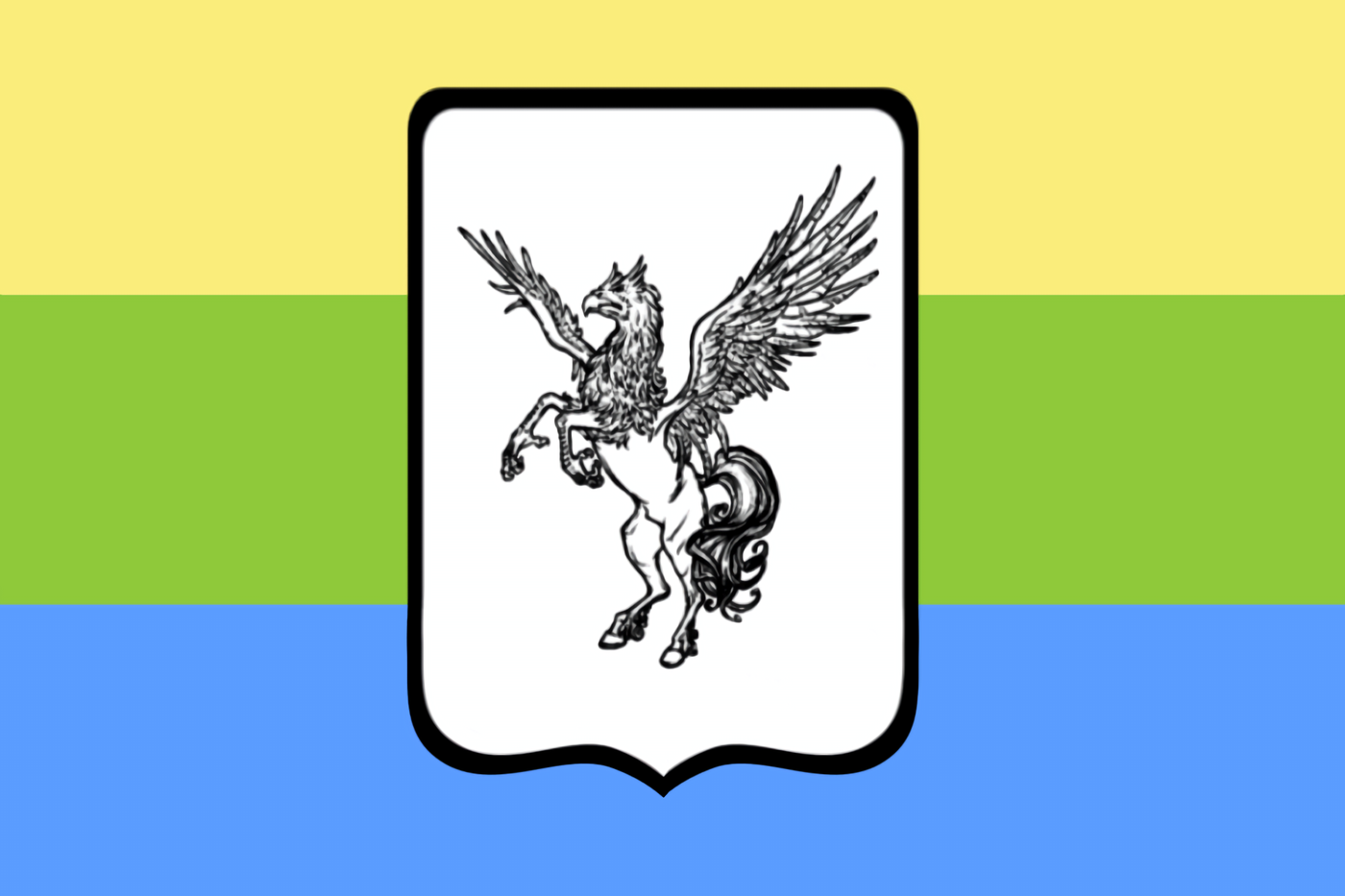
National animal
Article VII · The hippogriff, and why it is not the root
The national animal is the hippogriff. It is not the source of the country’s name. It was adopted later as a symbol of freedom, intelligence, strength, dignity, guardianship, and the bond between human and animal. The horse half echoes the older symbolism already carried by the name: bonds, movement, trust, companionship, duty of care, and the ability to return home. The national animal supports the name; it does not replace its sanctuary meaning.
Philological basis. The analysis rests on the attested Old Norse noun hross and its genitive plural; the attested collective noun grið and its legal meanings; the historical English noun grith; and standard Old Norse genitive-compound formation. Where the deeper prehistory of a root is uncertain, Hrossagrithic explanation marks it as uncertain rather than converting a proposal into fact.